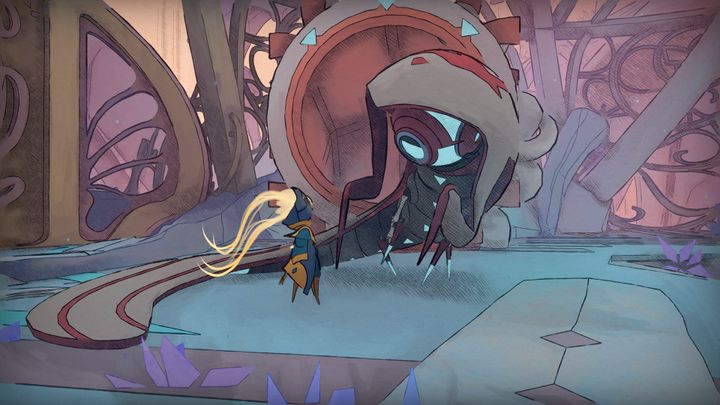

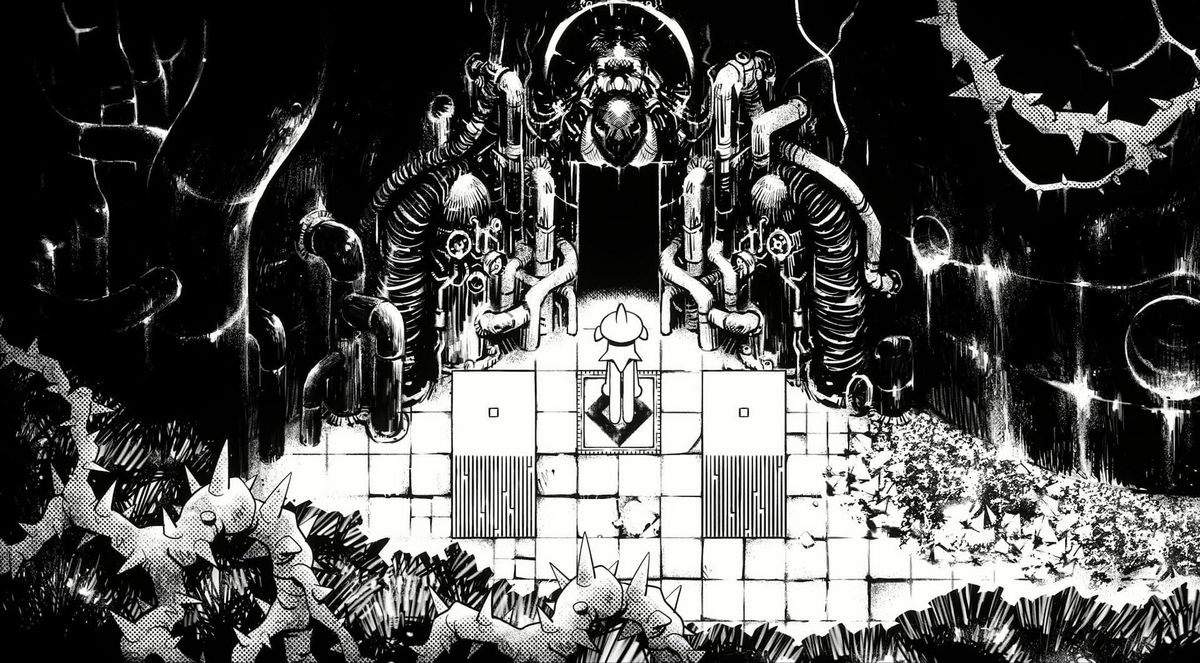
Despite a narrative that eventually leads nowhere, Badass Mongoose's maximizing of its intentionally minimalist look and feel, should be applauded. Helix: Descent N Ascent, despite its monochrome attire, is a far denser and thus entertaining puzzler than it initially appears.
It might've taken a while – a couple of decades and one or two bold visionaries to be the first to risk the ire of public perception – but the notion of decoding, deciphering and knowingly, maybe even excitedly, partaking in the act of literal note-taking, has almost become an entirely stand-alone sub-genre of puzzle games in its own right. Tunic, Chants of Sennaar, Outer Wilds, Lorelei and the Laser Eyes, Animal Well. Games whose nature of deduction and recollection rely on a player's willingness to refer back and make sense of the jumble of notes nearby.
Over the past half-decade, there's been a surge of games whose grandest delights are in the very act of discovery-come-applying of such knowledge to previously unfathomable states. Some would maybe denote these types of games Metroidbrainia's because of the parallels they share, via that very deciphering what was once indecipherable surroundings. Exploring the unknown, quickly transitioning to application of what is now known.
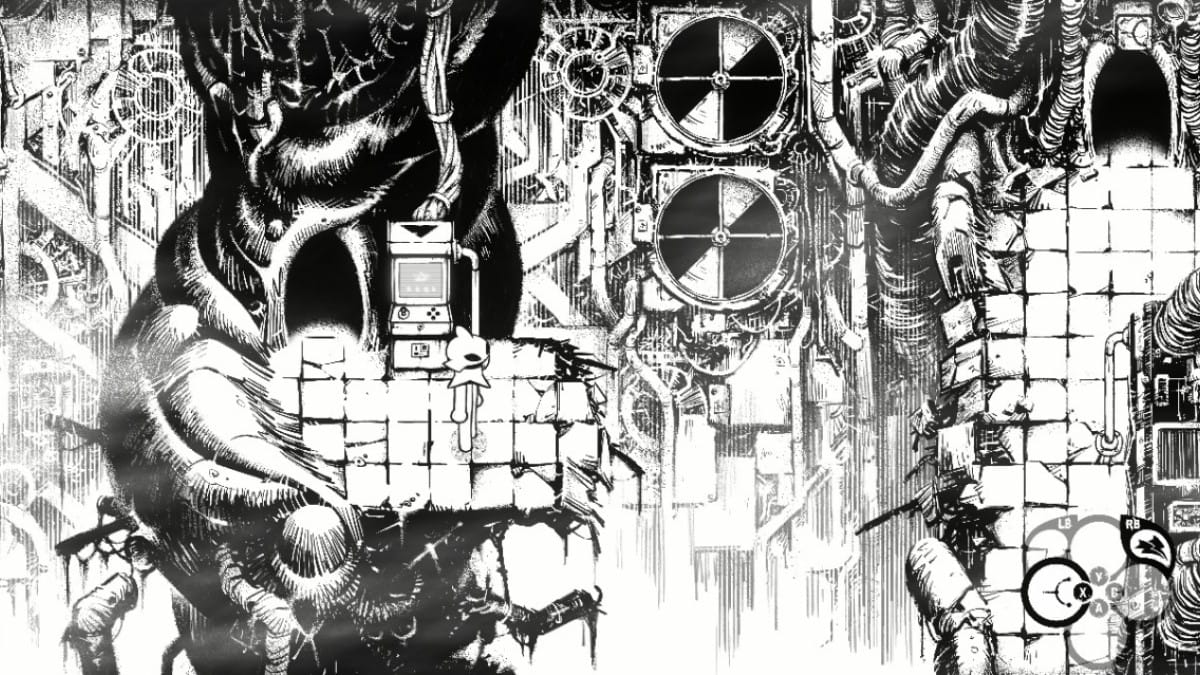
Regardless of one's affinity (or lack thereof) for unofficial monikers, it's evident that for a game like Helix: Descent N Ascent, action via context – the meaning behind the symbols – is very much at play here. Tipping its hat to a game like Tunic above all else – cryptic surroundings with similarly-cryptic symbols to decode – but one whose more mix-and-match approach to ability-gathering and ability-utilizing, prevents developer Badass Mongoose's efforts here, from feeling like cheap imitation.
Even if, sadly, its narrative backdrop – and thus the promise of grander discoveries beyond such symbols – do fall by the wayside. What Helix lacks to match its contemporaries with in some follow-through on its deliberately-obtuse, obscuring world-building, its more critical puzzle-solving elements, certainly make up for. This, despite the inevitable set-of-three structure its sequence of conundrums generally settle into: three switches to activate, three gates to open, three main doors to clear before you obtain the coveted prize of a new permanent ability/symbol.
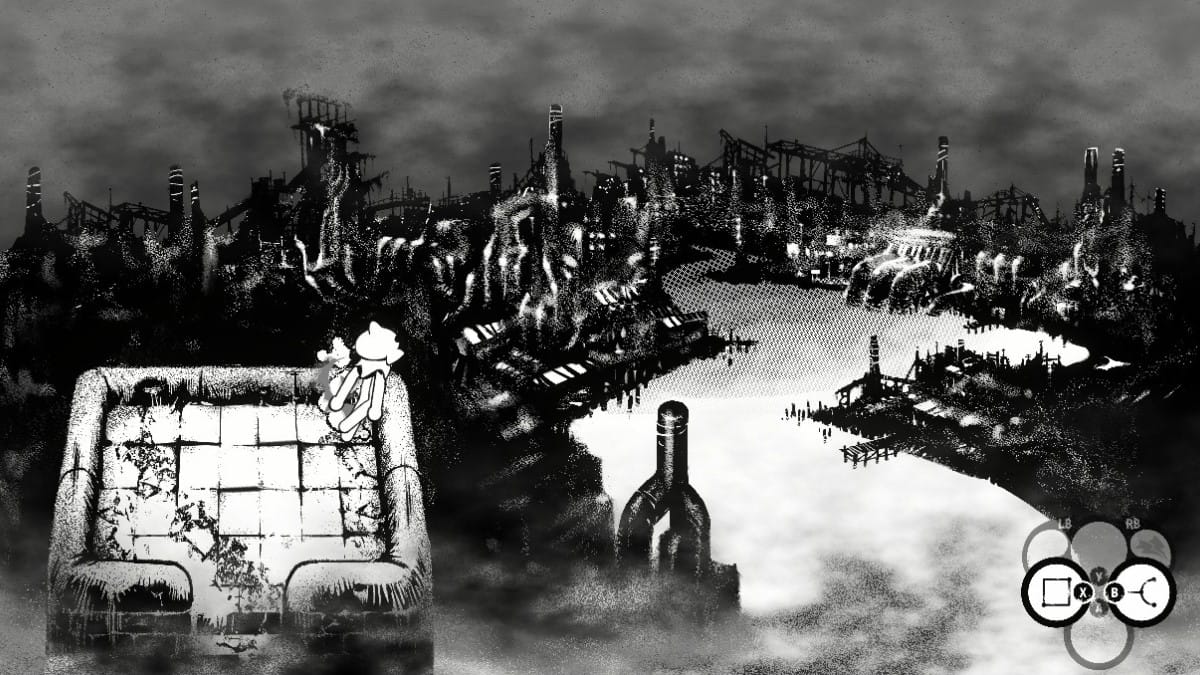
Sigils that act as the game's de facto progression meter. Acquire enough and you're granted passage to one or perhaps more than one ending. Less than satisfying these conclusions end up being, Helix is undoubtedly a case of the journey mattering more than the end destination. Even if such a journey comes paved with one or two unfortunate distractions. Or more annoyingly, one or two occasions of technical incompetency by way of, for example, clipping through walls and finding one's self soft-locked to the point of having to restart entire puzzle sequences.
Worse still, being rendered lost and unsure that the rooms you're even being allowed to enter are in fact critical to the solutions...or are in fact, as it turns out, parts of future puzzles you haven't reached yet. Helix sometimes underestimates the influence its simplistic, black-and-white attire can have. And the fallacy this can present to a game that is more complex in construction than it actually is. Not to say there aren't one or two instances of surprise overlap when it comes to hunting down optional collectibles. But multi-layered, Helix is not.
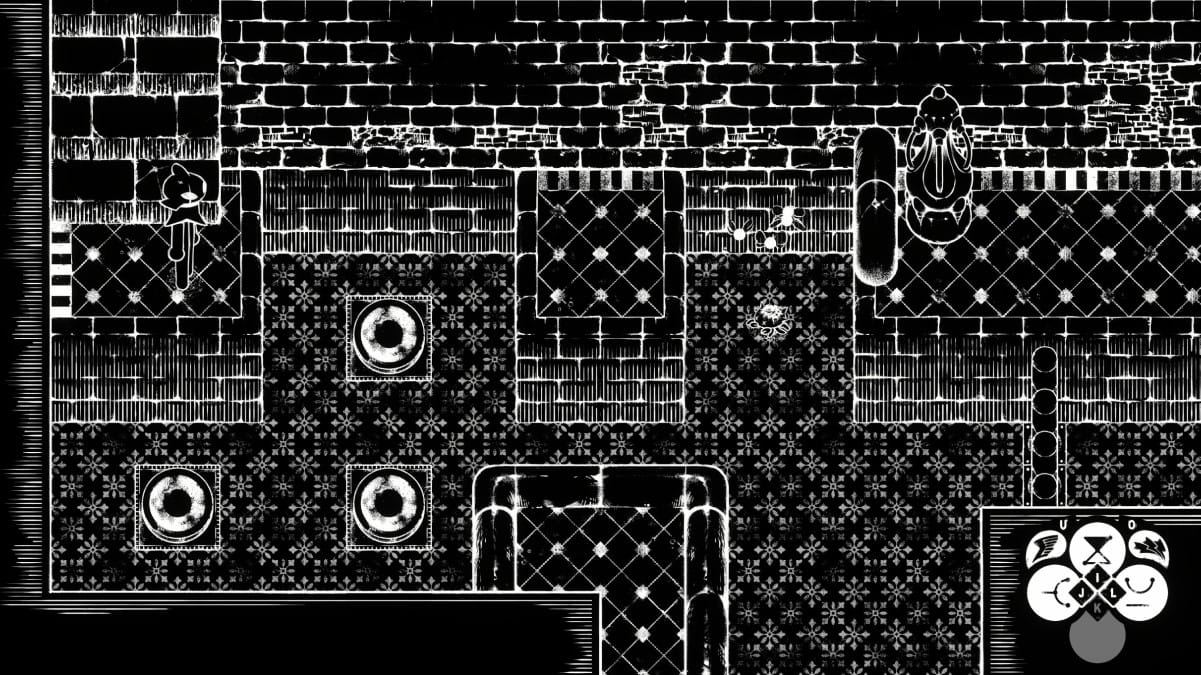
But it's perhaps more surprising that such an art-style as the one in Helix: Descent N Ascent, feels far from stagnant as it does. The in-game time spent steadily rolling into double-figure hours, Helix's implementation of this purely black-and-white, hand-drawn attire is commendable. It's in the game's two-tone artistic direction, that plaudits should initially go. The game's use of such filters like half-tone patterns or scratch marks particularly – effects that should grow tired and stale fairly quickly, but whose measured and carefully-considered application, provides much-needed density and intrigue as to the game's level design.
Intrigue that thankfully, Helix treats as a means rather than an end, to inspire further investigation on the player's end. A buzzing of flies suspiciously isolated to one given area that lo and behold reveals a hidden alcove or path. Objects that seem to flicker and waver, but with enough time invested provide an answer as to their state of being. Risky as the game remains in straddling that line between what particular items, objects, creatures etc. should be perceived as important or entirely irrelevant. What uncertainty that may pop up at intervals as to what is and isn't a key puzzle-solving element, Helix just about avoids with its variety of ideas and mechanics to discover.
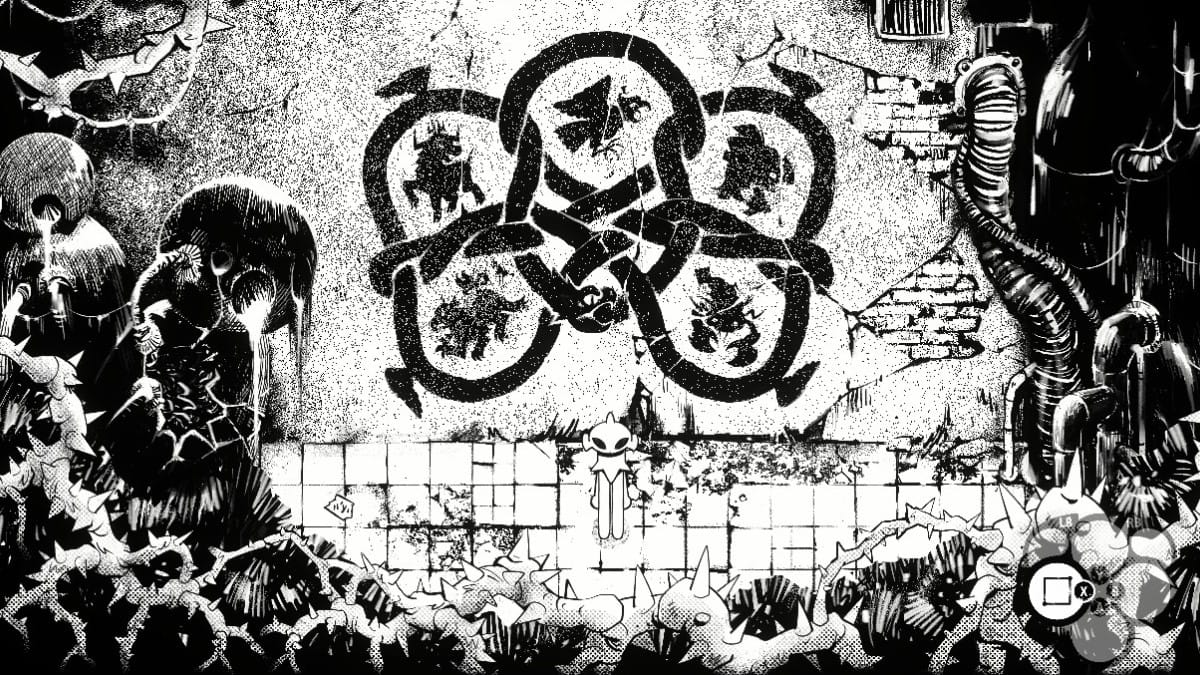
A variety whose reveals only ratchet up, when it comes to combining more than one symbol. Pillars you can spawn gaining an icy property when combined with an Hourglass sigil; said pillars being used in conjunction with a grapple to swap between positions. Helix runs on this persistent progression of requiring players to pick which ability (or abilities) to take into an overworld of sorts. Figuring out which gates/doors/chambers can be accessed with the tools currently equipped.
While there's generally only one section of the map players can access at any one time – with an in-game map providing guidance on where to head towards – part of the joy is in working out how to properly combine the two, eventually three, skills one currently has equipped. How their state of being even factors into the act of puzzle-solving itself.
It's this act of discovering how one skill/tool/ability impacts another – and how said tools further influence a third – that provides an effective moment of epiphany and theory-crafting. One tool allowing you to deploy a controllable drone whose remote nature means its time-limited. However, what if one were to attach the aforementioned grapple onto said drone. This compound of sigil-based abilities, further impacted by an otherwise irregular and non-consequential action such as, being able to capture small creatures like slugs or crabs dotted about a given space.
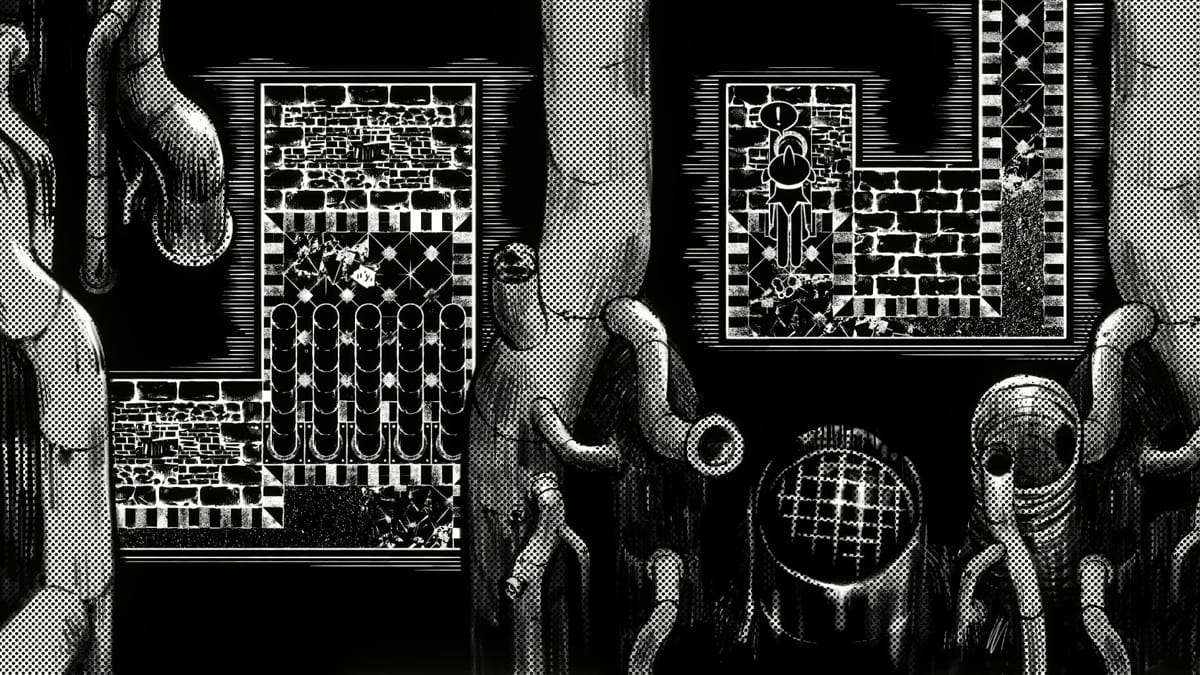
It may not ever leap out into any form of sandbox-like emergence and admittedly, the game does rely on some occasional leaps in logic in providing its solutions at times. But even so, Helix: Descent N Ascent's substituting in and out what tools are at your disposal, results in some interesting puzzle set-up's nonetheless. Set-up's that do veer into that precarious "slip up at any moment and you have to restart the process" balancing act, but are mostly sensibly-curated with just the right uptick in difficulty to match its placement.
Helix: Descent N Ascent ultimately convinces you to keep going for its increase in challenge and the lengths one must go to achieve victory. Even if, on a technical level, the game can slip up by way of an item or tool not working as intended sometimes. Using that aforementioned grappling tool to hop from one elevated platform to another....only to have the game struggle to administer one's request of movement. You know what to do, but Helix – albeit rarely – refuses to comply. A rare, minor annoyance but a crease in what is generally a well-constructed puzzle-adventure full of unexpected gameplay twists and revelations.
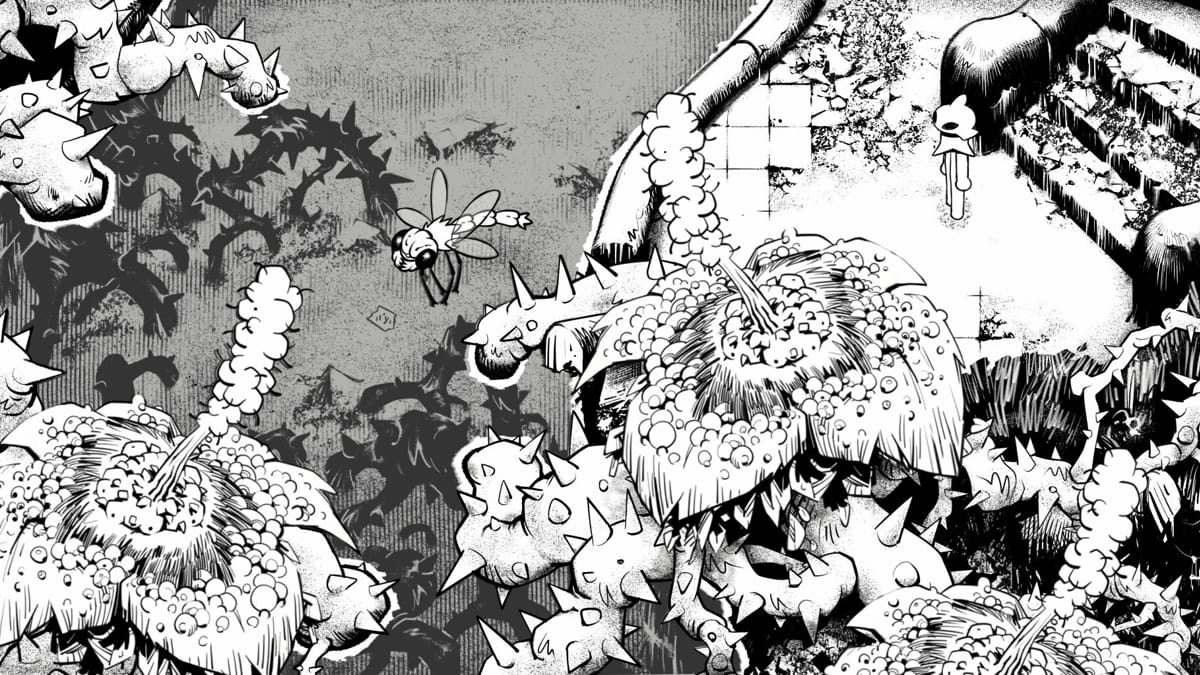
Where the game falters in its otherwise shallow and lacking narrative backdrop – tidbits of lore and implied world-building that don't really amount to anything significant – Helix: Descent N Ascent invests (and invests to a sizable extent) in the puzzle-solving aspects that matter most. Namely its slew of interesting tools and mechanics to utilize that make progression a steady stream of delightful revelations to unpack. Developer Badass Mongoose's admiration for the games that have come before is clear to spot, but in no way does this come across as pure imitation. Maybe not as multi-layered or as daring, but at the very least curious and visually-effective all the same.