


While its anime-inspired narrative falters off the track, on it Milestone's daring, quasi-futuristic reboot to the 90's arcade-racer series, just about wins through. Providing enough of a learning curve and pure mechanical delight, to look past its less-flattering aspects.
While I'd never pass on a racing game that places onus on the deft, finer touches to managing one's self on the track – ample WRC entries for example, have proven such emphasis on even the most minute of details, can be a worthwhile investment – "arcade"-style approaches have always been the more personal go-to preference. Not because they're streamlined, easier to pick up from the get-go and/or offer liberties with managing/controlling one's vehicle. Quite the opposite; it's the very many ways developers have attempted to up the ante, to evolve the basic formula, that offers an interesting question: where does one draw the boundary between what constitutes as quintessentially "arcade"-like...and what doesn't?
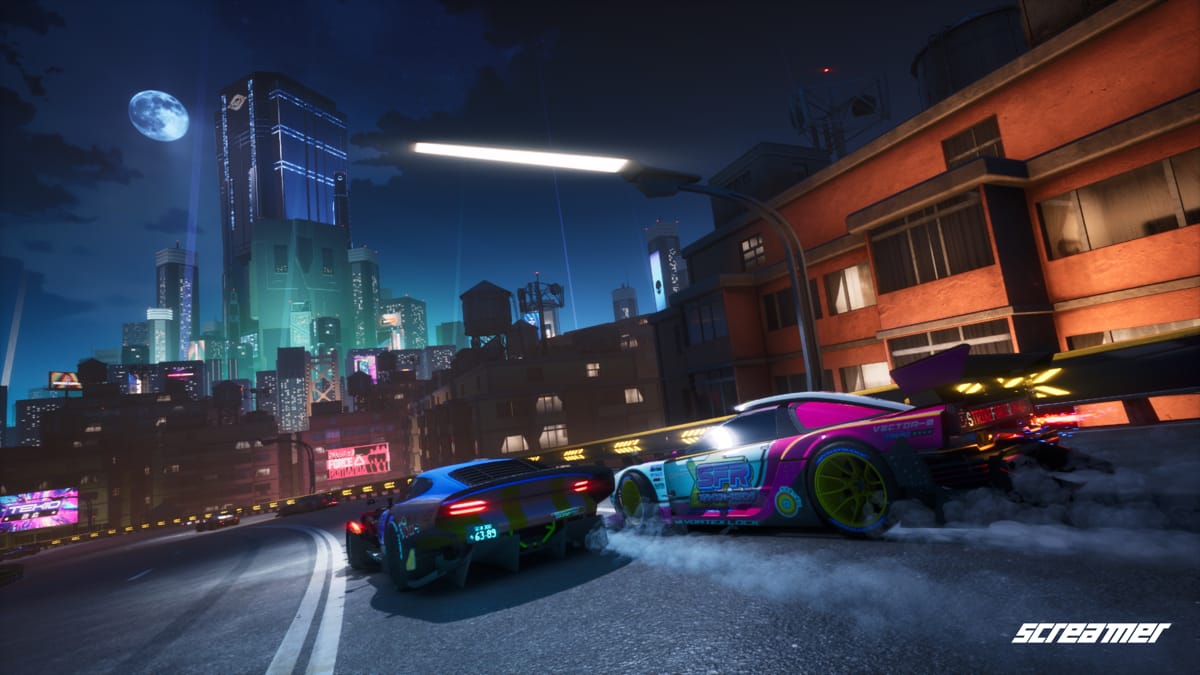
Be it modern-day or futuristic locales alike – conventional petroleum motors or hypothetical anti-grav technology – what strategic or tactical nuance is there to consider? Atop a well-worn formula whose basic objectives amount to: go fast, avoid corners, win? What, in this case, can reshape the thrill of challenge and investment? Of making the most of one's time on the track...and perhaps off it too.
Such fleeting yet punctuating moments via a split-second decision paying off (or going all-too-awry by contrast) frequently populate one's time in this year's Screamer. Milestone's emphasis on drifting, building up speed and frequent changing of gears to knowingly put one's self at high-speed risk, may initially come across as too tall an order. Haplessly sliding side to side, hitting the barriers more times than you'd dare openly admit, in the opening couple hours, as if the race track is coated in ice. And if the need to balance numerous meters governing both offensive and defensive combative functions aren't enough of a consideration, consider Screamer's controls are governed by both analog sticks – one for angling, the other for drifting.
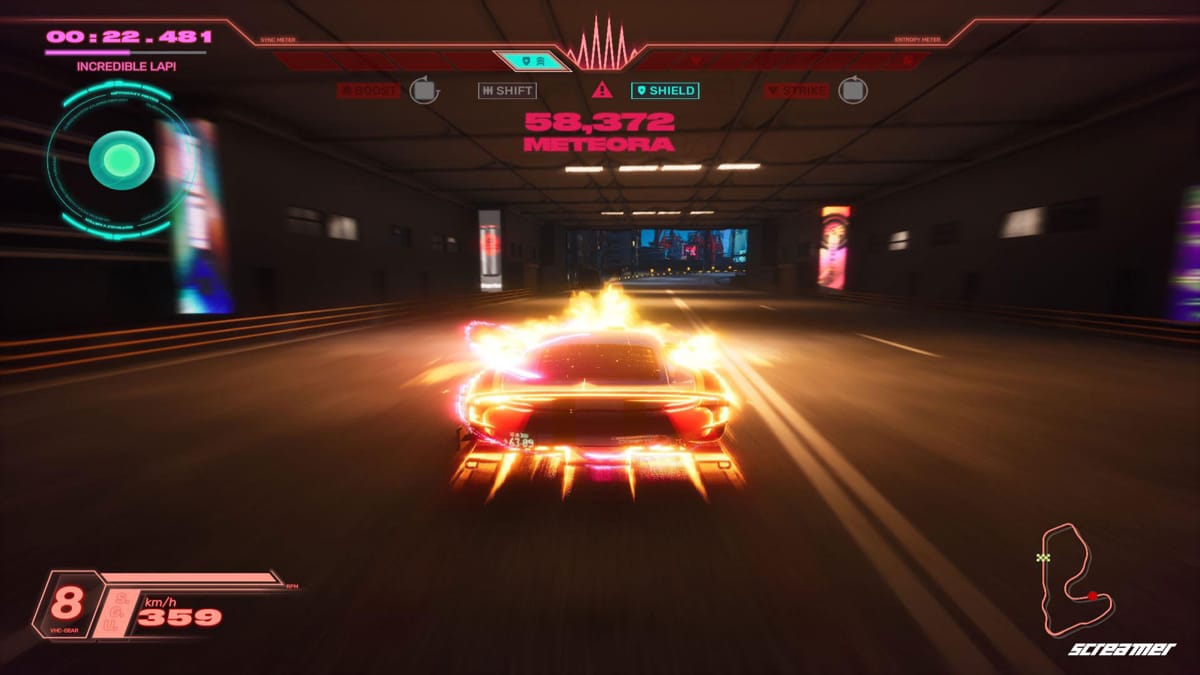
Screamer certainly throws plenty at you from the off. An uphill struggle that isn't aided by just how brief and lacking the game's introductory tutorial is in getting players accustomed to the style of controls Screamer is focusing on. "Do a few drifts. Done? OK, we'll presume you're an expert at this now," is the rather naive line of thinking you get, from the way Screamer seems to very hurriedly dispense with players unsure on how to even approach this.
While there's nothing inherently wrong with not wanting to waste time – keenly wanting your player-base to get stuck into things – for a game like this, of deft, minute decisions, the lack of any real sizable tutorial in Screamer, is disappointing. Yes, most (if not all) the game's equivalents are stowed away in its single-player/campaign mode, dubbed The Tournament – more on that in a bit – but a dedicated practice mode or means to teach the in's and out's, wouldn't have gone a miss.

Instead, there is no novice/intermediate/expert incline to return to, in properly understanding how best, for example, to treat a slight bend, curve, corner or full hairpin. No proper instructing on the balance between speed and angle of drift. No mention of racing lines, nothing. If a game like Lumines Arise can offer a sizable delving into its mechanics (in a game about making bigger and bigger squares on a grid), Milestone and Screamer has no excuse for giving newcomers so cold a welcome.
Look past its rough start however and thankfully, Screamer does eventually start to glisten, if not shine entirely. The game's initially perplexing interpretation of controls, fortunately becoming second-nature in no time. Gracefully balancing how much emphasis to place in each analog stick. Listening out for audio cues to shift gears, without having to hurriedly glance at the bottom-left of your screen, to see your speedometer pass the threshold between blue and orange. Itself feeding back into the game's overall premise of knowing how best to maximize one's speed, without putting yourself at risk of crashing out.
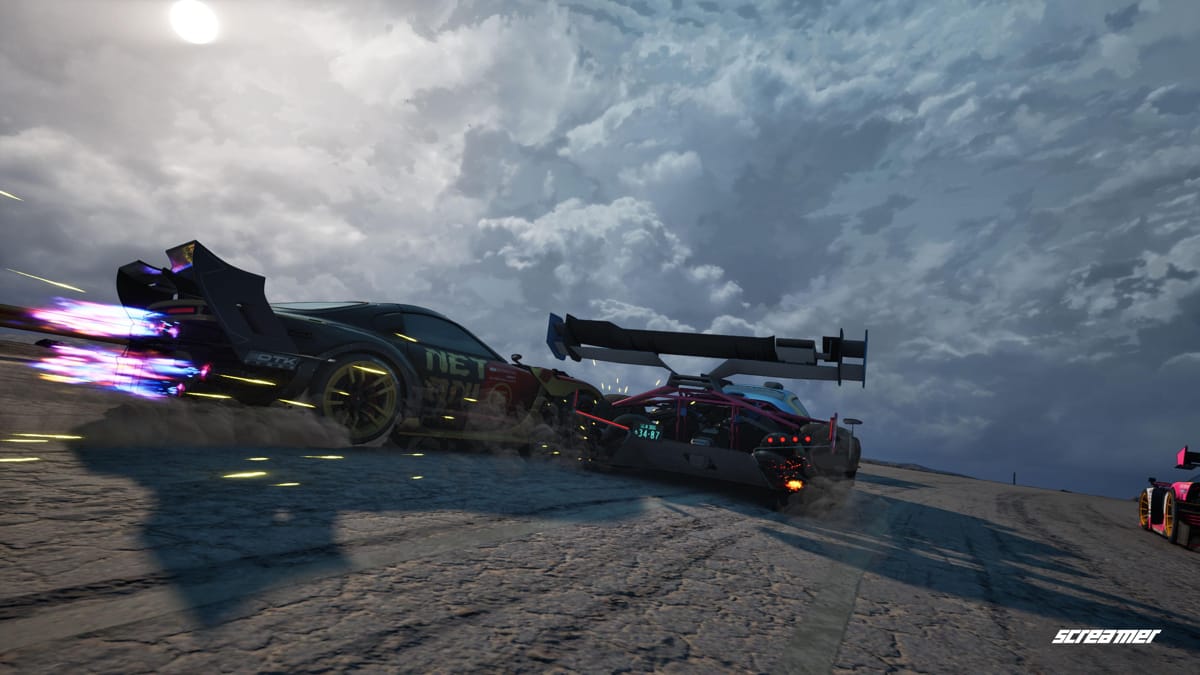
As noted, this approach to meter-management is eventually expanded, as weaponry and utilizing your vehicle [temporarily] as a battering ram against opponents, comes into play. Think Mario Kart's star item, minus the musical jingle. Again, there's a period early on where it seems like Screamer is fated to alienate via such convoluted a set-up – syncs, shifts, entropy just some of the lingo one has to hurriedly learn, memorize and frantically determine which is best for a race of wildly changing circumstances.
Yet it doesn't and commendation eventually has to be thrown Milestone's way for how the game continues to motor on with this same "it finally clicks" energy. More than once I found myself convinced that after a spur of good fortune, Screamer would inevitably peter out and lose what favor it had garnered up to that point.
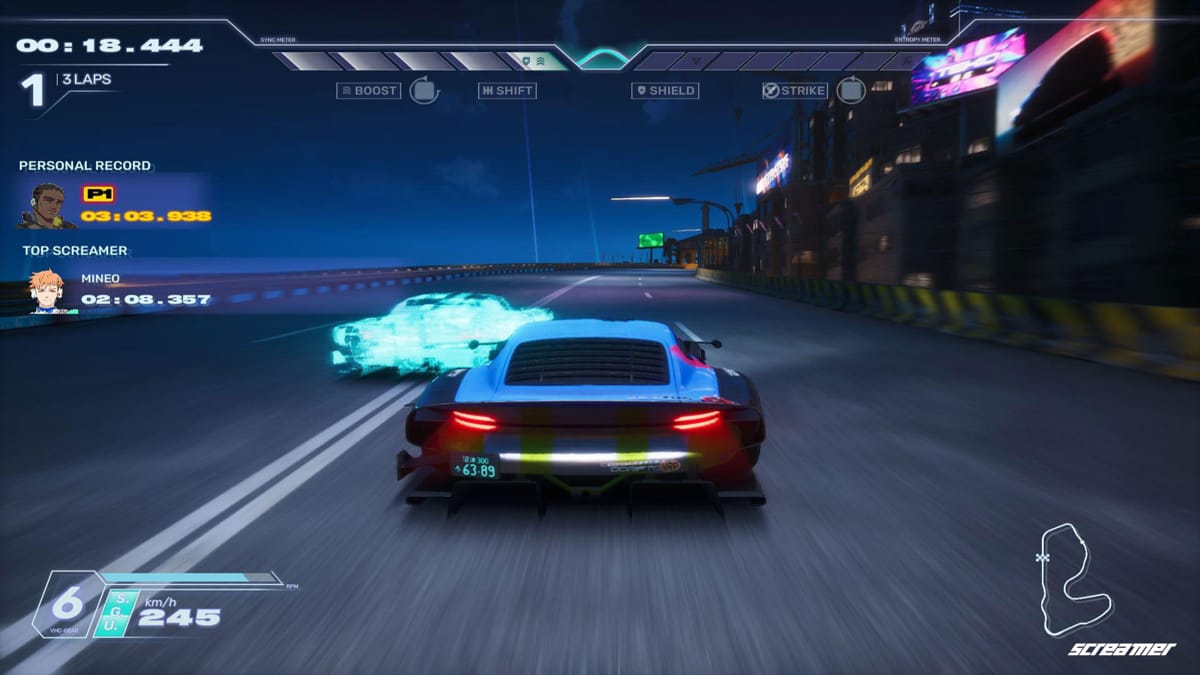
A feeling that isn't helped by the behavior of AI in parts. Or more specifically, what Screamer determines is a reasonable or ample challenge, with just how wildly inconsistent a result that can end up being. Screamer, at its worst, ramming its thumb one too many times on the scales, in giving its AI participants a helping hand or three. Opponents appearing to perform on another level during the last couple of laps of a 5-lap race, with abnormal increases in speed.
Likewise, able to conveniently make their way around sharp corners without any sign of drifting in their movement. Or worse, somehow able to maintain their lead (sometimes find that their lead increases) despite one's use of a boost. Thankfully, a near last-minute balance patch put out by the developers a few days prior, has alleviated a vast chunk of this irregularity. But while AI behavior, at the time of writing, has now settled predominantly into a more fairer range, relative to one's chosen difficulty, Screamer can still find itself at the behest of the racing genre's most unwanted tropes when it comes to approaching difficulty in a racing game. Unexpected rubber-banding and all.
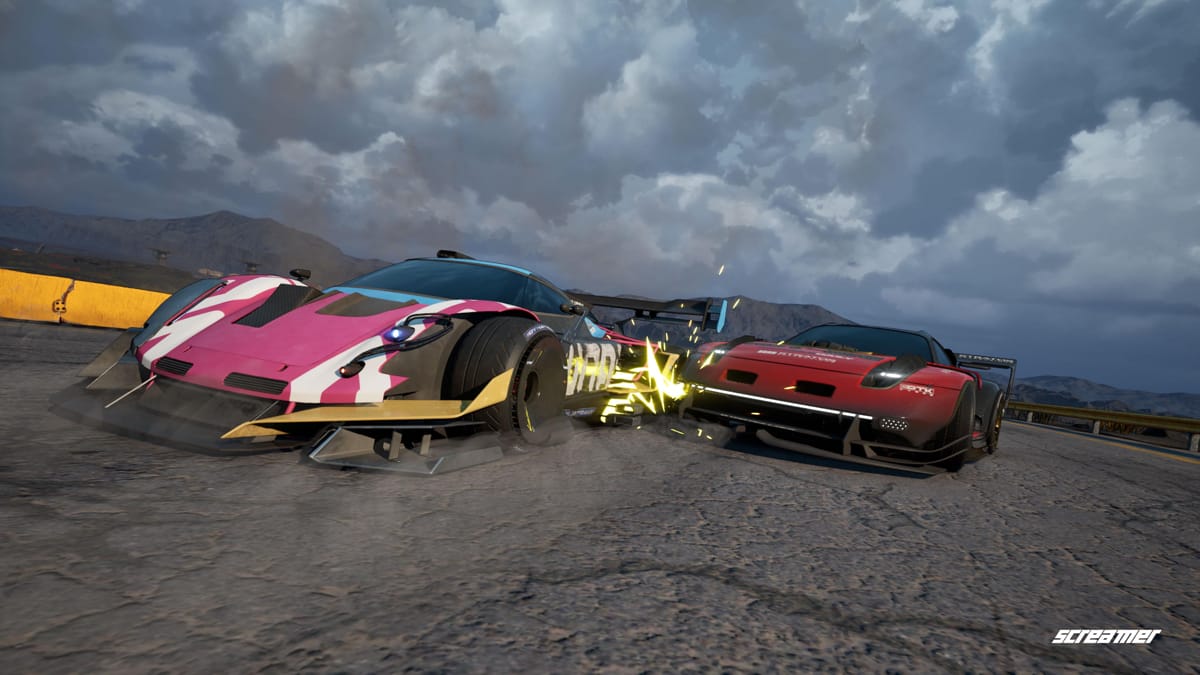
Perhaps the biggest make-or-break for Screamer – and no doubt the mode that will most likely split opinions from players – is its single-player story mode. Arguably (and quite surprisingly) the meatiest slice of content in so far as length and breadth, yet one that still, through execution, can make Screamer feel at points as wide as an ocean but as deep as a puddle.
The game would have you believe it has all the hallmarks of a multi-season anime – missions/objectives split up into "episodes" with character-specific interludes sprinkled about. And on paper, the premise, for how ridiculous and far-fetched its plot stands, does entice. Much like the gameplay mechanics themselves, the story relies heavily on a hefty dose of "just roll with it" which Screamer, again to its credit, gets away with. Five teams of three; characters from a multitude of countries, all speaking their native language. All of whom, oh so conveniently able to understand one another – a crucial detail the game very quickly deals with through the most dispensable of throwaway lines.

All of whom, entering the titular Screamer tournament in pursuit of the game's unifying Macguffin, the Echo device. What follows is a string of rather shallow, hurriedly cobbled-together melodrama masquerading as character arcs, interpersonal drama amongst teams and on occasion, some attempt to better explore this new rebooted world of Screamer. And while the story does offer some momentary potential or break from the tired 0-100 uptick in drama or stakes, Screamer's need to balance more than dozen characters, finds the game painting an understandably thin and hollow canvas.
Which is a shame, as ridiculous as its premise and unraveling story beats are, it's that very ludicrous set-up, that manages to offer a flair of personality to things. The very idea of a band of PMC contractors facing off against scientists, a Japanese pop band, ex-Yakuza and someone many would deem riddled with Nepotism – facing off in deadly, illegal street races of all things – is exactly the kind of pitch, if anything, the game should've doubled-down and leaned more heavily into.
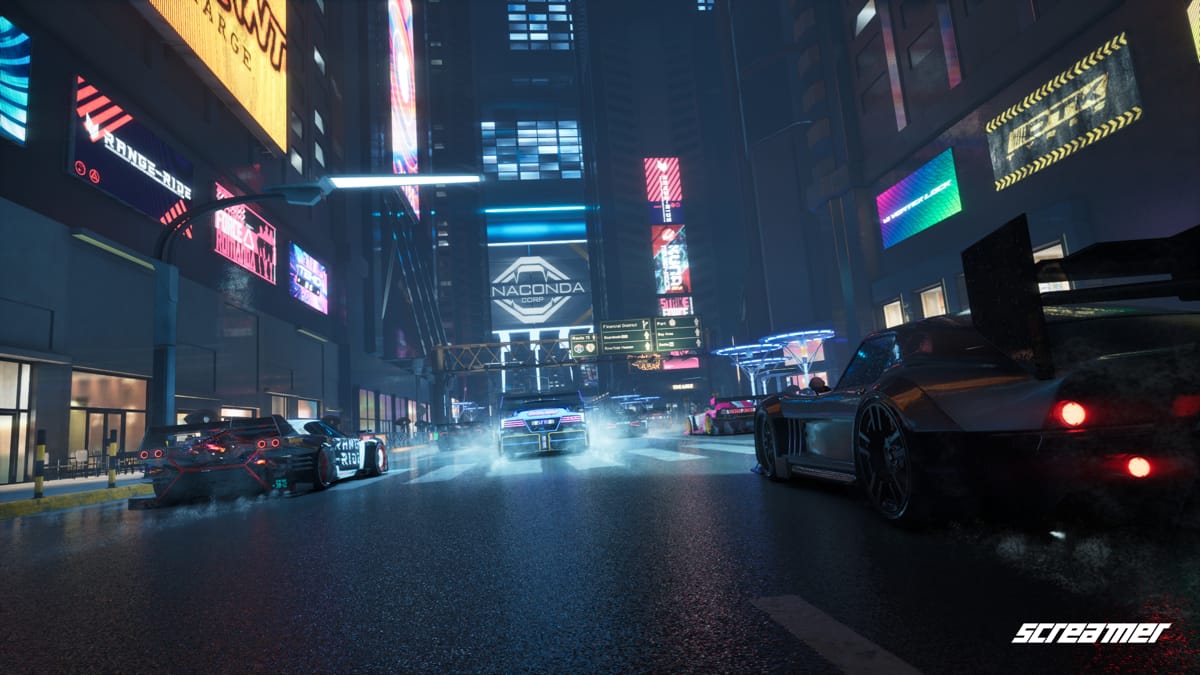
Instead, whether it's the choppy synchronizing of character profiles making some attempt at conversing, an all too noticeable recycling of the same race tracks, or generally little to invest in or incur about its grander setting – similarly repetitive use of flashbacks and referring to events past not helping the story's flow. The game's giddy and shameless (justifiably so) embracing of its premise, promising as it may be, inevitably devolving to that of slogging through static backgrounds – of which are on occasion broken up by animated cutscenes – hoping that glimmer of an interesting character or exchange between two such personalities, becomes something more.
Yet it's what Milestone manage to establish first and foremost in the gameplay department, that will keep most perceiving Screamer as that of a glass half-full game, rather than that of one half-empty. This, despite its less-than-welcoming introduction and the fact players will no doubt incur a rocky first hour or two, before the mechanics of the game's twin-stick interface, finally start to kick in.
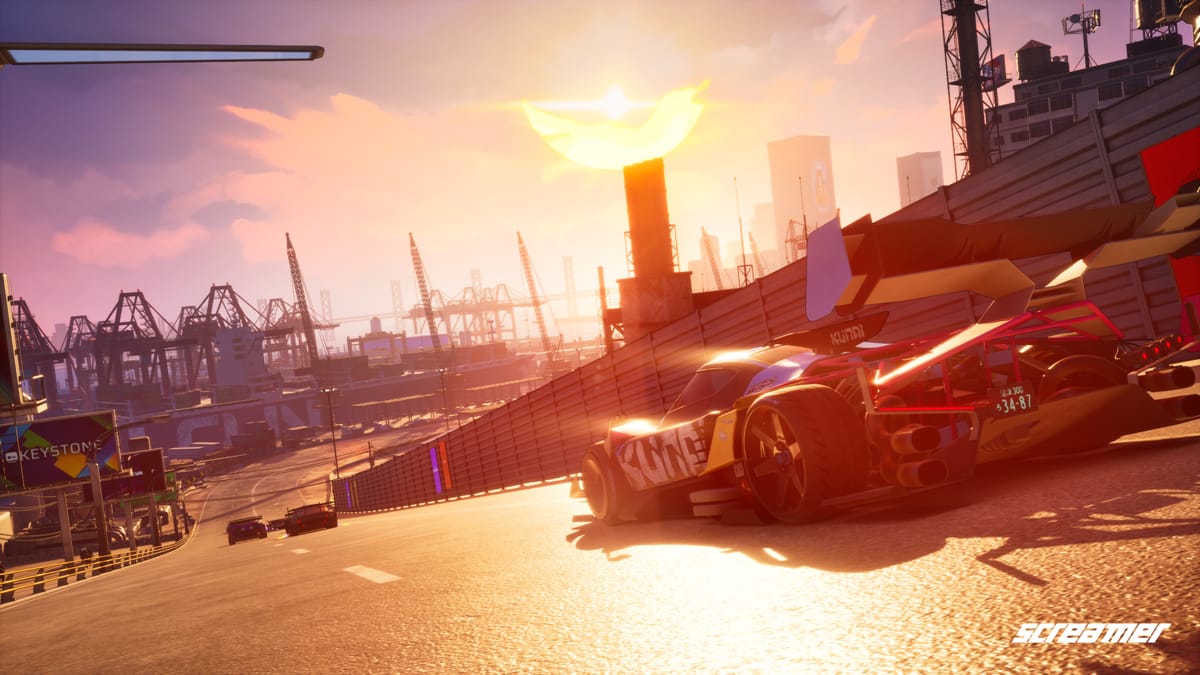
Unfortunate it may be this year's reboot and its resolute transitioning to this more stylized, outlandish presentation, doesn't quite translate to a story campaign worth highlighting, Screamer still offers enough arcade thrills and mechanical nuance to delight and keep enthusiastic fans coming back for more. Look past the shallow surface detail and you'll find that Milestone's genre expertise, remains undeniable.